


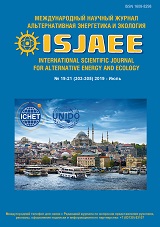
 Scientific and practical peer-reviewed journal
The international scholarly journal Alternativnaya Energetika i Ekologiya (“alternative energy and ecology”) - ISSN 1608 - 8298 is one of the world’s leading scholarly journals on issues related to alternative energy and ecology and is the organ of the International Association for Hydrogen Energy and the International Association for Alternative Energy and Ecology. The journal’s primary focus is on large-scale scientific research projects of a priority nature.
The journal is also concerned with the study of various issues related to hydrogen energy and hydrogen transportation and discussion of a wide spectrum of issues in alternative energy and ecology as a whole. In addition, the journal covers issues related to the safety of transportation systems and that of hydrogen transportation.
Readers are provided with the opportunity to delve into original, never-before-published, research studies in the area of physico-mathematical, engineering, and chemical sciences across the following groups of specialties: Physics, Kinetics and Catalysis, Ecology (engineering and chemical sciences), Aviation and Rocket and Space Technology, and Energy.
Most of these are studies conducted by members of the Russian Academy of Sciences, as well as members of other academies and leading scientists from around the world. In addition, the journal receives regular input from researchers at training institutes, universities, and research institutes across Russia.
The journal is intended for specialists in the area of physico-mathematical, engineering, and chemical sciences and is published twice a month. 4 new issues of the journal come out every two months and issues are not merged together.
The journal’s English titles are:
- International Journal of Hydrogen Energy (IJHE)
- International Scientific Journal for Alternative Energy and Ecology (ISJAEE).
- Solar Energy
The best works on energy generation published in International Scientific Journal for Alternative Energy and Ecology are also published in International Journal of Hydrogen Energy, and translated versions of the works from International Journal of Hydrogen Energy which are of interest for International Scientific Journal for Alternative Energy and Ecology are published in the latter.
International Journal of Hydrogen Energy (IJHE) (Elsevier) is issued 4 times per month and has high scientometric indices such as Global citation indices - Journal Metrics: Source Normalized Impact per Paper (SNIP): 1.424; SCImago Journal Rank (SJR): 1.338; Impact Factor: 2.930 (Thomson Reuters Journal Citation Reports 2014); 5-Year Impact Factor: 3.448 (Thomson Reuters Journal Citation Reports 2014).
All the papers published in IJHE are included in SCOPUS, and Web of Science, as well as in the following indexing systems:
Indexed/Abstracted in: Chemical Abstracts (Online), Chemical Engineering and Biotechnology Abstracts (Online), Chimica, Compendex, Currents Abstracts, Current Contents, EnCompassLit, Energy * Power Abstracts, Inspec, PubMed, Referativnyi Zhurnal, Russian Academy of Sciences Bibliographies, Science Citation Index Expanded, TEMA-Technology and Management, Web of Science, Also covered in the abstract and citation database SCOPUS.
The scope of topics presented in International Scientific Journal for Alternative Energy and Ecology is approved by the International Association for Hydrogen Energy, editorial board of International Journal of Hydrogen Energy, and UNIDO-ICHET.
Original scope of topics presented in International Scientific Journal for Alternative Energy and Ecology overlaps with the whole scope of topics presented in International Journal of Hydrogen Energy and includes issues relating to renewable power generation, non-renewable power generation, and clean generation technologies.
Editorial board of International Scientific Journal for Alternative Energy and Ecology includes renowned scientists from 25 countries of the world. Among the worldwide known members of editorial board of International Scientific Journal for Alternative Energy and Ecology, the following scientists shall be mentioned at the first turn: Vladimir Yevgenyevich Fortov, the President of the Russian Academy of Sciences (since 2005), academician Yury Alekseyevich Trutnev (since 2000), academician Anatoly Sazonovich Koroteyev (since 2003), academician Nikolai Nikolayevich Ponomarev-Stepnoi (since 2003), professor C. Marchetti (since 2008), professor Michael Douglas Hampton (since 2000), doctor Boris Petrovich Tarasov (since 2000), doctor professor Viktor Alekseyevich Goltsov (since 2000), and many others.
For its activities, International Scientific Journal for Alternative Energy and Ecology won many international scientific awards, including Monetary Award of International Association for Hydrogen Energy (IAHE): in 2000 and 2014; the Silver Medal of Roentgen (2007), Diploma of the Vernadsky Fund and the RF FA State Duma Committee on Environment (2007), award of Russian Energy Olympus (2008), and other international scientific awards.
Editorial board of International Scientific Journal for Alternative Energy and Ecology has conducted more than 10 High-Level International Scientific Forums, among which the most remarkable are IFSSEHT (2000, Russia, Sarov) and the 1st International Congress on Alternative Energy and Environment WCAEE-2006 (Volga) (2006, Russia, Sarov).
Since 2000, peer-reviewed International Scientific Journal for Alternative Energy and Ecology (ISJAEE) http://isjaee.hydrogen.ru has published scientific articles and scientific reviews in academic and applied sciences written by renowned scientists from 50 countries of the world, which confirms the high scientific level and topicality of the journal.
Since 2000 International Scientific Journal for Alternative Energy and Ecology (ISJAEE) ISSN 1608-8298 has played as the most important channel of relevant information exchange between the East (the Russian-speaking community) and the West (the English-speaking community).
Impact Factor of Russian Science Citation Index (2014) together the translated version is 0,577. Two-year Impact Factor of Russian Science
Citation Index (2014) - 0,555. h-index for 10 years - 10. Herfindahl index of the authors’ organizations – 261.
The journal is registered in UNESCO in ISSN International Centre in 2000 (key title: “Al’ternativnaâ ènergetika i ècologiâ”, abbreviated key
title: “Al’tern. ènerg. ècol.”), ISSN 1608-8298. The subjects of the journal are approved by International Association for Hydrogen Energy (IAHE).
The journal has been included into the “List of leading reviewed scientific journals and editions in which the basic scientific results of dissertations
on competition of scientific degrees of Doctors and Candidate of Sciences (Ph.D. and Sc.D.) should be published” according to the decision of
Presidium of the Higher Certifying Commission.
The journal has been included into catalogues: “Rospechat’” (20487), Joined catalogue “Press of Russia. Russian and foreign newspapers and
journals” (41935), “Interpochta-2003”.
Journal awards: Röntgen Medal (2007), Award of V. I. Vernadskyi fund and RF State Committee for Ecology (2007). The Premium “Russian
Energetic Olympus – 2008”.
The journal has been included into the abstract journal and data base VINITI. Information on the journal is annually published in the international
reverence system of periodical of current issues “Ulrich’s Periodicals Directory”.
Full version of papers has been presented at Scientific electronic library http://e-library.ru, web-site of International Scientific Journal for Alternative
Energy and Ecology http://isjaee.hydrogen.ru, and International Information and Education Portal “Hydrogen” http://www.hydrogen.ru.
The journal has been registered at Russian Federal Service on Supervision of Observance of the Legislation in Sphere of Mass Communications and Protection of a Cultural Heritage (Certificate PI No FC77-21881) September 14, 2005.
Position of ISJAEE in SCIENCE INDEX rating for 2012 – 9740; in General Rating for 2012 – 291; on the topic “Environmental Protection. Human Ecology” – 7; on the topic “Energy” – 1
Translated version of International Journal of Hydrogen Energy is included into Scopus and Web of Science as well as international databases.
Current issue
 Open Access
 Subscription or Fee Access
ВОЗОБНОВЛЯЕМАЯ ЭНЕРГЕТИКА. СОЛНЕЧНАЯ ЭНЕРГЕТИКА
This article presents the results of studies on the physical properties of hydrogenated amorphous thin films of a-Si1-хGeₓ:H, a-Si:H, and a-Ge:H alloys deposited by plasma-enhanced chemical vapor deposition. The optical constants (n, n₁, α, R, T, and d) and the optical band gap of the studied films, E₀ = 1.05-1.85 eV, were determined. The optical properties of the films were investigated under different deposition conditions, including film thickness, hydrogen partial pressure, substrate temperature, and hydrogenation level. It was established that variations in the technological parameters lead to the formation of different structural phases.
The deposited a-Si1-хGeₓ:H, a-Si:H, and a-Ge:H films exhibit a mixed, two-phase structure consisting of nanocrystallites distributed within an amorphous matrix. The concentrations of carbon and hydrogen in the a-Si1-хGeₓ:H films depend strongly on the deposition conditions and the composition of the initial gas mixture (SiH₄, H₂, and GeH₄). The properties of the films are strongly influenced by their composition and hydrogenation level. The hydrogen content was varied by changing the composition of the gas mixture and was determined by infrared (IR) absorption spectroscopy for a-Si:H and a-Ge:H films.
The changes in the electrical and photovoltaic characteristics of the films, as well as the effect of radiation on their properties, were investigated. Solar cells based on a-Si:H and a-Si₀.₈₈Ge₀.₁₂:H films were fabricated in two-layer, threelayer, and combined two- plus three-layer cascade structures, and their performance characteristics were measured. For a cell area of 1.5 cm², the maximum power conversion efficiency (η) reached 18.9 %.
HYDROGEN ECONOMY
The use of thermal power plants (TPPs) as facilities for large‑scale hydrogen generation can significantly reduce the cost of the produced alternative fuel. This is facilitated by the availability of spare land plots, access to energy resources, and the well-developed infrastructure of TPPs. The prospects for hydrogen production at steam turbine and combined-cycle TPPs have already been assessed. The aim of this study is to evaluate the potential for hydrogen production via gasification of municipal solid waste (MSW) at gas turbine TPPs using simulation modeling techniques. A scheme for integrating an MSW‑to‑hydrogen unit into the configuration of a gas turbine plant (GTP) at a TPP has been developed. A simulation model of a power unit based on the SGT-800 gas turbine has been created. The joint operating modes of the GTP and the MSW‑to‑hydrogen unit have been analyzed. The range of hydrogen production and MSW utilization volumes has been determined. It has been found that for this type of GTP, the maximum hydrogen generation volumes amount to 10.8‑35.8 t/h, while the processed MSW volumes range from 468.8 to 608.3 t/h. This indicates that a single power unit equipped with an SGT‑800 turbine and an MSW‑to‑hydrogen unit is sufficient to process the entire volume of MSW fractions suitable for gasification generated in a city with a population of several million people. It was established that hydrogen production and MSW processing volumes decrease by 8.5 % with an increase in the ambient air temperature from −30 to +30 °C, and by 24.4 % with a reduction in the GTP load factor from 100 % to 30 %. Conversely, when the hydrogen share in the synthesis gas increases from 25 % to 75 %, the production volume rises by 67 %. To expand the hydrogen production capabilities of GTP‑based TPPs, it is necessary to include a unit in the process scheme that recovers the high-temperature waste heat from the synthesis gas for district heating supply to external consumers.
Integrated utilization of municipal solid waste (MSW) and the development of low-carbon fuel production technologies, including hydrogen, are widely recognized decarbonization pathways aligned with the Sustainable Development Goals. The development of low-carbon projects based on existing energy infrastructure can support a balanced transition to new technologies and improve the utilization efficiency of existing equipment. This study assesses the feasibility of integrating a hydrogen production complex based on MSW gasification into the infrastructure of an operating combined heat and power plant (CHP) equipped with PT-type turbines. The Petrozavodsk CHP plant (Petrozavodsk, Republic of Karelia, Russia) was selected as the research object. The MSW potential of the Republic of Karelia for refuse-derived fuel (RDF) production was assessed, and the composition and yield of syngas were determined for air, air-steam, and oxygen gasification. A thermal scheme of the steam-turbine unit was developed in which industrial-extraction steam is used for carbon monoxide conversion. A syngas heat-recovery scheme with reheating of steam downstream of the high-pressure cylinder was also developed. Gasification modeling showed that the maximum hydrogen output (0.336 t/h) is achieved with air-steam gasification, while fuel consumption increases by 0.4 % relative to the baseline mode. The minimum increase in fuel consumption is observed for oxygen gasification (0.03 %), which also provides the lowest hydrogen output (0.199 t/h). Modeling of operating modes with syngas heat recovery showed that air gasification reduces fuel consumption by 0.15 % relative to the baseline mode. The choice of gasifying agent for hydrogen production from RDF depends on the objectives of integrating the MSW-to-hydrogen complex.
Dark fermentation (DF) of organic waste is a promising approach for biohydrogen production, but the efficiency of this process depends significantly on complex interactions between process parameters and interspecies relationships within microbial consortia. In this study, a comprehensive optimization of DF of cheese whey (CW) using a binary culture of strains Clostridium butyricum SP4 and Clostridium beijerinckii SP6 was conducted by applying response surface methodology. It has been established that the optimal ratio of strains is 1:10 (SP4:SP6), at which a synergistic effect is achieved, presumably associated with the effective redistribution of metabolic pathways and utilization of intermediate products. Adequate mathematical models (R2 = 0.70-0.97) have been developed for the potential hydrogen yield (PHY), the maximum rate of hydrogen production (Km) and the lag phase (LPh). It has been shown that magnetite (0-400 mg/L) does not have a statistically significant effect on PHY and Km, but it significantly reduces LPh, which is likely due to increased availability of iron ions for the hydrogenase complex and accelerated adaptation of bacteria during the initial stages of fermentation. The optimal conditions for maximizing PHY and Km are: 400 mg/L of magnetite, pH 8.0 and stirring at 173.9 rpm, while the optimal values for minimizing LPh are: 400 mg/L of magnetite, pH 8.0 and stirringat 120.0 rpm. Validation of the models under optimal conditions confirmed their high predictive ability: the experimental values of PHY, Km and LPh differed from the predicted values by no more than 4.3 %. The addition of magnetite caused a shift in metabolism pathways towards the butyrate type of DF. The obtained results provide a scientific basis for managing the DF process of CW.
THERMODYNAMIC BASICS OF AEE. THERMODYNAMIC ANALYSIS IN RENEWABLE ENERGY
The integration of a steam methane reforming unit into oxygen-fuel energy complexes is a promising direction for improving the energy efficiency of the combined production of electricity and hydrogen with virtually complete capture of carbon dioxide. In this work, an oxygen-fuel energy complex based on the SCOC-CC cycle with the integration of a reformer into the gas-air path of a waste-heat boiler has been developed and studied. The thermodynamic study revealed that as the hydrogen mass flow rate increases from 0 to 3.68 kg/s, the fuel heat utilization factor rises from 49.5% to 74.3% and exceeds the corresponding value for a scheme with integration of a steam-methane conversion unit via intermediate steam superheating by 1.2-2.5 %.
ENERGY SAVING. ENERGY SAVING TECHNOLOGIES, MATERIALS, SYSTEMS, AND INSTRUMENTS
Hydrogen energy systems are rapidly becoming a central component of modern low-carbon energy infrastructures, driven by the global transition toward renewable generation, distributed energy resources, and flexible grid-support technologies. As hydrogen electrolyzers and fuel cells are increasingly deployed alongside photovoltaic arrays, wind turbines, battery storage systems and smart-grid interfaces, the demands placed on their power-electronic subsystems grow substantially. These systems must operate reliably under wide and unpredictable variations in input voltage, fluctuating load profiles, and dynamic interactions with the electrical grid. Ensuring stable, efficient and safe operation of hydrogen-based equipment therefore requires advanced conversion architectures and control strategies capable of maintaining precise output characteristics under real-world disturbances.
This work addresses these challenges by developing and analyzing a control system for a clamped series resonant converter (CSRC), a topology well suited for high-efficiency conversion in hydrogen energy applications. The CSRC offers inherent advantages such as reduced switching losses, soft-switching capability, and compact resonant components, making it a strong candidate for integration into hydrogen production and consumption units. However, its practical deployment requires a control system capable of adapting to wide input-voltage ranges and rapid load transitions while preserving soft switching and maintaining a stable output voltage essential for electrolyzer operation.
The proposed control system is based on pulse-frequency modulation with dual feedback loops that continuously monitor the input voltage and output current. This architecture enables the converter to autonomously adjust its switching frequency in response to external disturbances, ensuring that the resonant circuit operates within safe and efficient boundaries. The control strategy is designed to maintain a constant output voltage required for hydrogen electrolyzers, which are sensitive to voltage deviations and rely on stable electrical conditions to achieve high Faradaic efficiency, avoid membrane degradation, and ensure long-term operational reliability. By regulating the switching frequency rather than relying on classical voltage-mode or current-mode control, the system achieves fast dynamic response, reduced stress on semiconductor devices, and improved compatibility with hybrid energy systems.
A comprehensive simulation model of the converter and its control system is developed to evaluate performance under conditions representative of real hydrogen-energy installations. The model incorporates detailed representations of the resonant circuit, switching devices, feedback mechanisms, and logic components. Several critical operating scenarios are examined, including startup at maximum load, abrupt reductions and increases in input voltage, stepwise changes in load power, and transitions between low-power and high-power operating states. These scenarios reflect typical disturbances encountered in renewable-integrated hydrogen facilities, where input voltage may fluctuate due to solar irradiance variability or wind intermittency, and load demand may shift rapidly depending on hydrogen production schedules or fuel-cell power requirements.
Simulation results demonstrate that the proposed control system maintains the required output voltage with minimal ripple, preserves soft switching of semiconductor devices across all operating modes, and provides rapid dynamic response without overshoot or instability. The converter consistently adapts its switching frequency to compensate for external disturbances, ensuring uninterrupted and predictable operation. These characteristics are essential for hydrogen electrolyzers, which require precise voltage regulation to maintain stable electrochemical performance, and for fuel cells, which depend on controlled power delivery to avoid degradation of membrane-electrode assemblies.
Beyond the technical performance of the converter itself, the study highlights the broader significance of the proposed control method for hydrogen-energy integration. Modern hydrogen facilities increasingly operate as part of multi-vector energy systems, where electrical, thermal and chemical energy flows must be coordinated to maximize efficiency and grid stability. In such environments, power-electronic converters must not only regulate voltage and current but also contribute to system-level optimization, support coordinated control strategies, and accommodate the variability of renewable generation. The CSRC topology, combined with the developed control system, offers a promising solution for these requirements by providing high efficiency, fast transient response, and compatibility with distributed energy resources.
The findings of this work contribute to the development of reliable and scalable power electronic interfaces for hydrogen infrastructure. The proposed control method enhances the operational stability of electrolyzers and fuel cells, supports their integration into hybrid energy systems, and enables more flexible interaction with the electrical grid. The study also outlines pathways for future enhancement, including the incorporation of additional feedback mechanisms to compensate for long-term component aging, temperature-dependent parameter drift, and environmental variations. Further research will focus on developing experimental prototypes to validate the simulation results under real operating conditions and exploring the converter’s role in advanced grid-support functions such as demand response, frequency regulation and renewable smoothing.
Overall, this work provides a comprehensive foundation for the deployment of resonant-converter-based interfaces in hydrogen energy systems and demonstrates their potential to support the evolving requirements of renewableintegrated, grid-interactive hydrogen infrastructure.
INFORMATION FOR AEE
Announcements
2026-09-20
004-Международные Форумы: HYDROGEN-2026 - Пятая Международная конференция HYDROGEN-2026 в рамках Десятого Конгресса WCAEE-2026 (HYDROGEN-2026) (28 октября - 30 октября 2026 года).
| More Announcements... |


